
Designed an AI-powered matching feature to reduce manual patient identification
Administrative staff manually matched incoming documents to the correct patient records — a repetitive and error-prone process within high-volume intake workflows.
I designed an AI-powered matching feature that analyzes document content and suggests likely patient records, reducing manual identification effort while keeping administrators in control of final verification.
The feature was in active development at the time of my departure.
Understanding the problem
Methods:
- Workflow exploration
- Comparative analysis with another EMR's patient matching feature
Our PM presented the initial problem: admins were spending significant time manually splitting documents, identifying patient information and confirming matches with the system, all tasks that could benefit from automation.
To deepen my understanding, I reviewed:
- The existing manual workflow
- How a different EMR within the company handled patient matching (even though their flow differed, it served as a useful reference point)
Defining key design goals
I was then able to establish the following high-level goals:
- Reduce the time spent on matching documents with patients
- Simplify handling for documents containing multiple patients
- Minimize errors that could result in misplaced information
- Provide a clear and trustworthy review process for AI-generated matches
Ideation & exploration
I explored several conceptual flows:
- How to introduce AI recommendations early
- How to keep admins from performing unnecessary manual steps before AI runs
- How to visually indicate match confidence
- How to handle edge cases (e.g., documents manipulated before upload, causing the AI to fail)
Iterative design
Method: Internal design reviews with the PM, BA, and developer — including team members from the other EMR's AI Matching project
Approach: Low-fidelity mockups → interaction flows → clickable prototype → iterative refinements
I worked closely with internal team members who had experience with patient matching in the other EMR. These review cycles helped refine the workflow and ensure the AI interaction felt clear, trustworthy, and aligned with existing processes.
Key insights from iteration:
- Users needed to understand why the AI couldn't match a document
- Confidence indicators needed to be clear and non-technical
- The flow for multi-patient documents required special attention
- Admins should be encouraged to use the AI before performing any manual steps
- Clear next steps (select, review, fix and confirm) to help reduce uncertainty
Final design solution
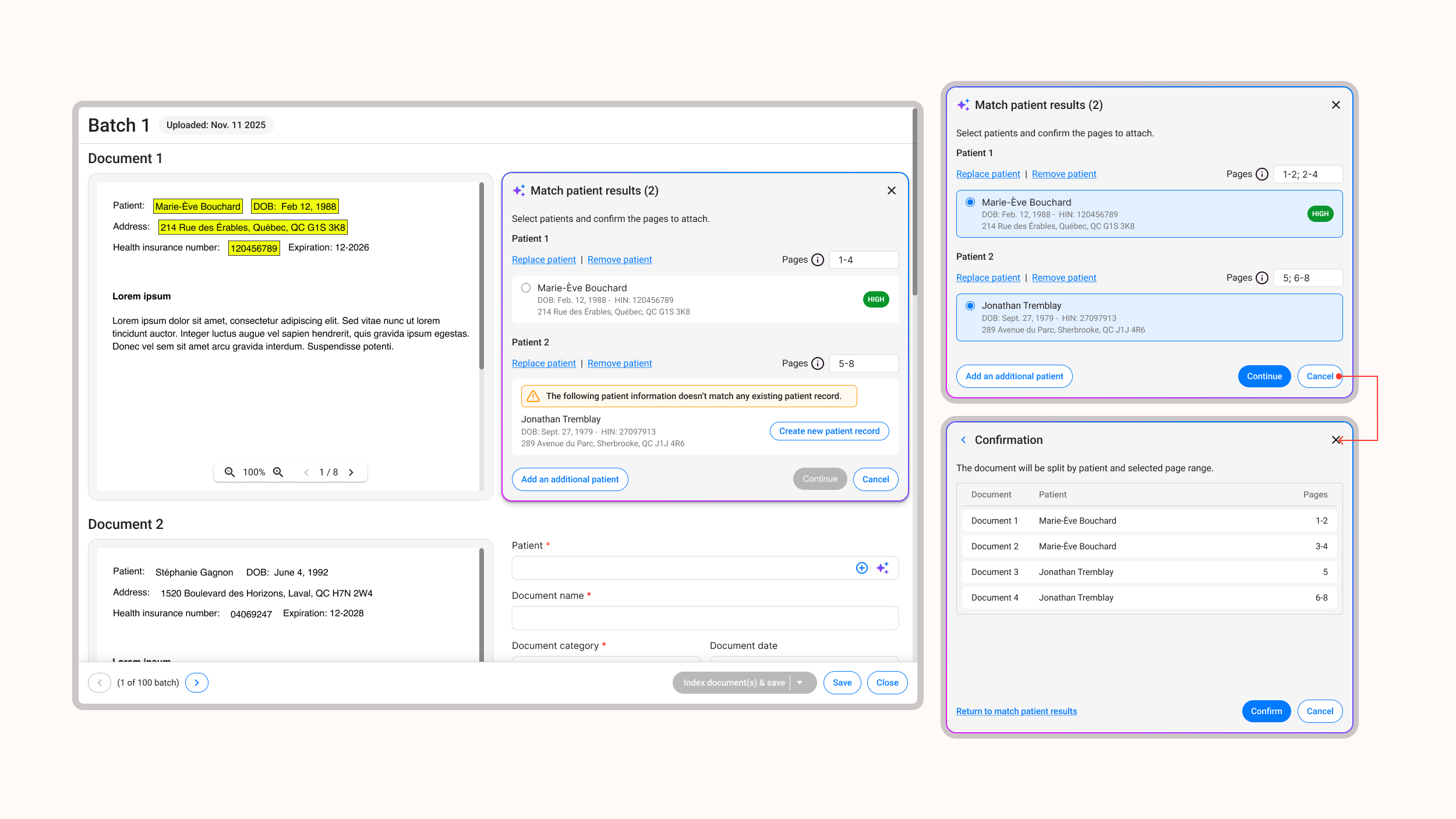
✓ AI-generated patient matches: A clean review interface where admins see suggested matches alongside confidence indicators.
✓ Multi-patient document handling: A clear workflow for verifying and correcting documents that include multiple patients.
✓ Error / No-match scenarios: Guided interactions explaining next steps if the AI could not confidently match a document.
✓ Manual override: A streamlined way for admins to adjust or correct AI matches without losing context.
✓ Intelligent workflow entry points: The system encourages users to let the AI process documents first, rather than beginning with manual tasks.
Outcome
Internal validation confirmed the AI flow was clear, well-structured, and ready for development. Drawing from an existing patient matching solution in another EMR, the design was adapted to handle a larger and more complex workflow.
The feature was in active development when I left, with plans for multiple phases to refine and expand the experience based on real usage — a sign of a scalable foundation.
Reflection
This project showed how important it is to design AI workflows that feel transparent and trustworthy.
I included it because AI-driven efficiency is becoming essential in healthcare and this work reflects my ability to design for complex data-sensitive processes.