
From Manual to AI-Assisted Patient Matching
I integrated an existing AI-assisted patient matching solution into a complex electronic medical record (EMR) document indexing workflow. Staff can review AI-suggested patient matches and document splits while retaining the flexibility to work manually, with the goal of reducing repetitive tasks and indexing time.
Building on existing AI technology
The business wanted to introduce AI-assisted patient matching quickly by reusing technology developed for another EMR product within the company.
The goals were to:
Reuse existing AI technology rather than build a new solution.
Keep manual document indexing available.
Adapt the experience to our EMR's existing design patterns.
Understanding where AI could help
I evaluated the existing AI solution alongside our EMR's document-indexing workflow to understand how the two could work together.
Reviewed its capabilities and functionality.
Worked with the product team to identify where AI assistance could be introduced.
Examined complexities around document splitting and patient matching.
Balancing AI capabilities with manual control
Working with product and engineering, I navigated technical constraints while preserving user flexibility and making AI limitations clear.
Preserving manual flexibility despite AI limitations
Manually splitting a document disabled AI assistance. I advocated for a more flexible approach, but the limitation had to remain for the initial release.
The trade-off: Preserve manual splitting so staff could continue their work, even though AI assistance would become unavailable.
How I addressed it:
- Communicating the impact: Added a warning before users proceeded with manual splitting.
- Restoring AI assistance: Provided a reset option to restore AI assistance.
Open document
AI assistance available
Choose to split
Manual splitting selected
Confirm impact
AI assistance will be disabled
Index manually
AI assistance unavailable
Accommodating AI processing limitations
The existing technology had a 50-page limit per document, and processing times varied with upload volume.
The trade-off: Keep documents available for manual indexing when AI couldn't process them, while clearly communicating AI status and limitations.
How I addressed it:
- Settings expectations: Communicated the 50-page AI limit during upload.
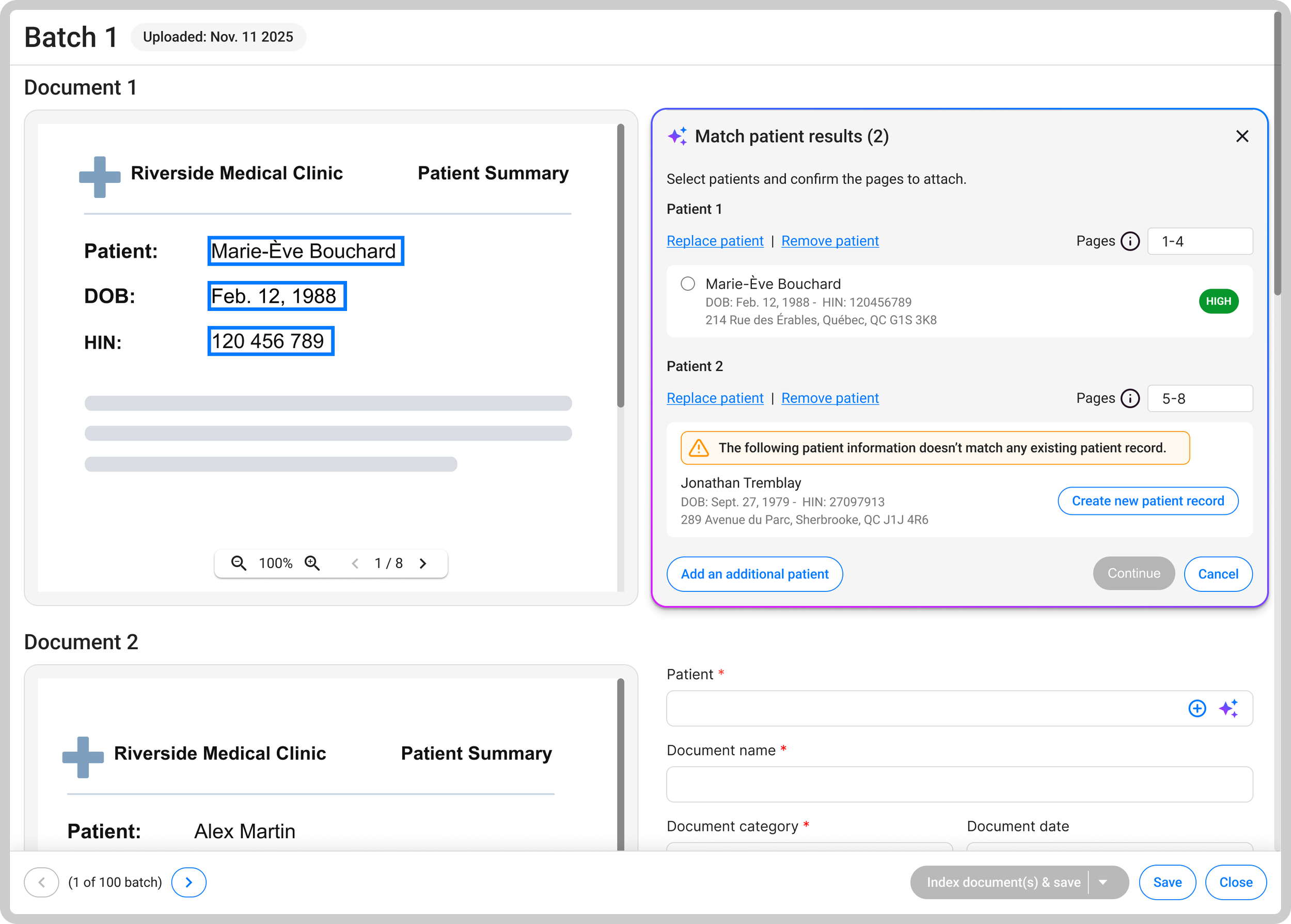
- Providing status visibility: Used familiar icons and tooltips in the batch list to show AI processing status and availability.
- Explaining limitations in context: Added contextual messages on the indexing screen when AI assistance was unavailable.
Upload documents
Add files to a batch
Page-limit notice
Explain 50-page AI limit
Batch created
Documents ready for indexing
Batch list
Show AI availability
Open document
Explain why AI is unavailable
Integrating AI into the indexing workflow
Making AI processing visible
I designed status indicators, tooltips and contextual messages to communicate AI processing progress, availability and limitations, helping staff understand AI status during indexing.
AI-assisted patient matching with manual control
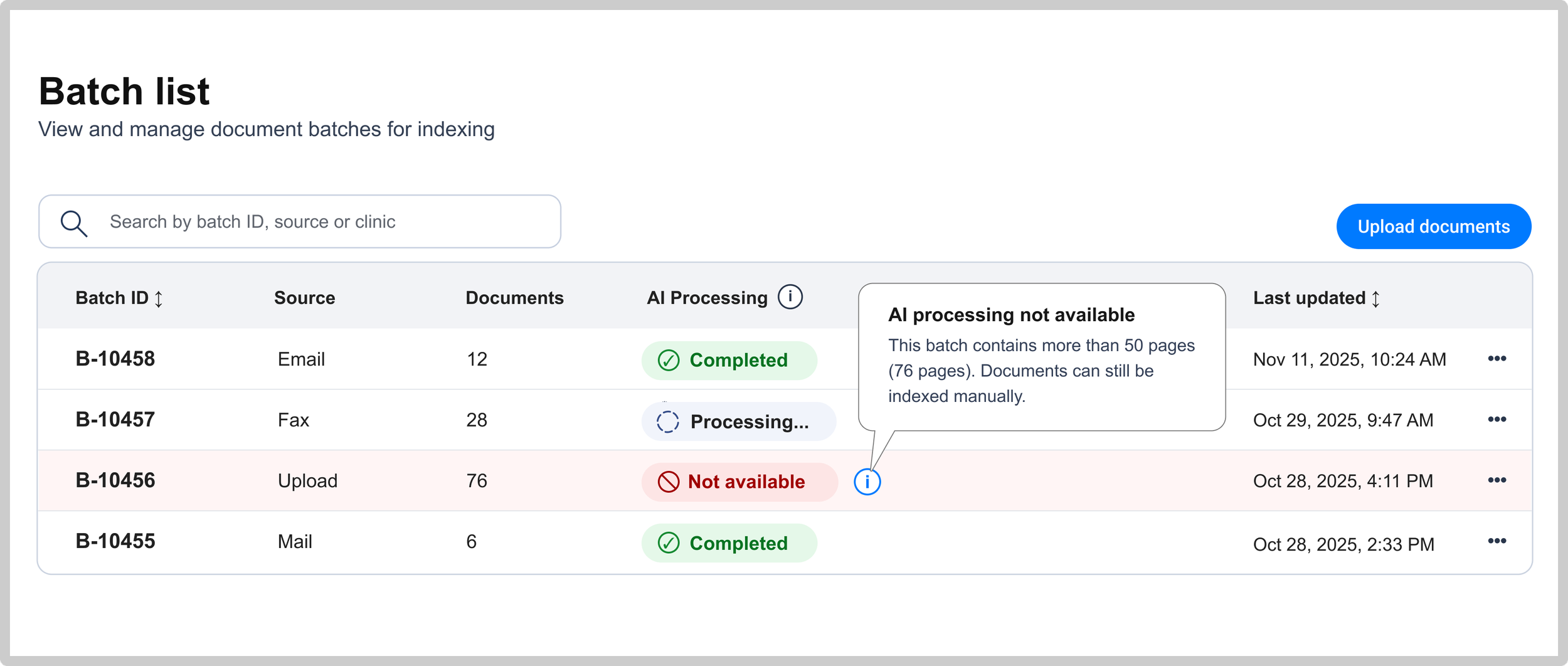
AI suggested patient matches to reduce manual lookup and data entry, while keeping staff in control of the indexing process.
- Review and adjust: Staff could review and modify AI-suggested patient matches and document splits.
- Index manually: Staff could complete these tasks manually when needed.
- Maintain flexibility: AI assistance remained optional, allowing existing workflows to continue alongside the new functionality.
Document 2: Shows the default manual indexing state, with the option to activate AI using the icon in the patient field.
Reducing repetitive work through AI assistance
The feature was still in development when I left, so post-launch results were not yet available.
Reduce indexing effort
Minimize repetitive work reviewing documents and matching patients.
Support accurate matching
Help staff identify the right patient while retaining control of final decisions.
Advance AI adoption
Support the company's AI initiatives, with the goal of improving operational efficiency.
Balancing AI assistance with human control
This project reinforced the importance of transparent, trustworthy AI experiences in healthcare. It challenged me to adapt existing technology to a more complex workflow while balancing technical constraints, accuracy, and user control.
Back to top ↑