
Reduced manual entry for adjudicators by centralizing and standardizing claim intake
Incoming claims from mail, email, and fax required adjudicators to manually enter information from scratch — creating redundant effort and increasing the risk of data-entry errors.
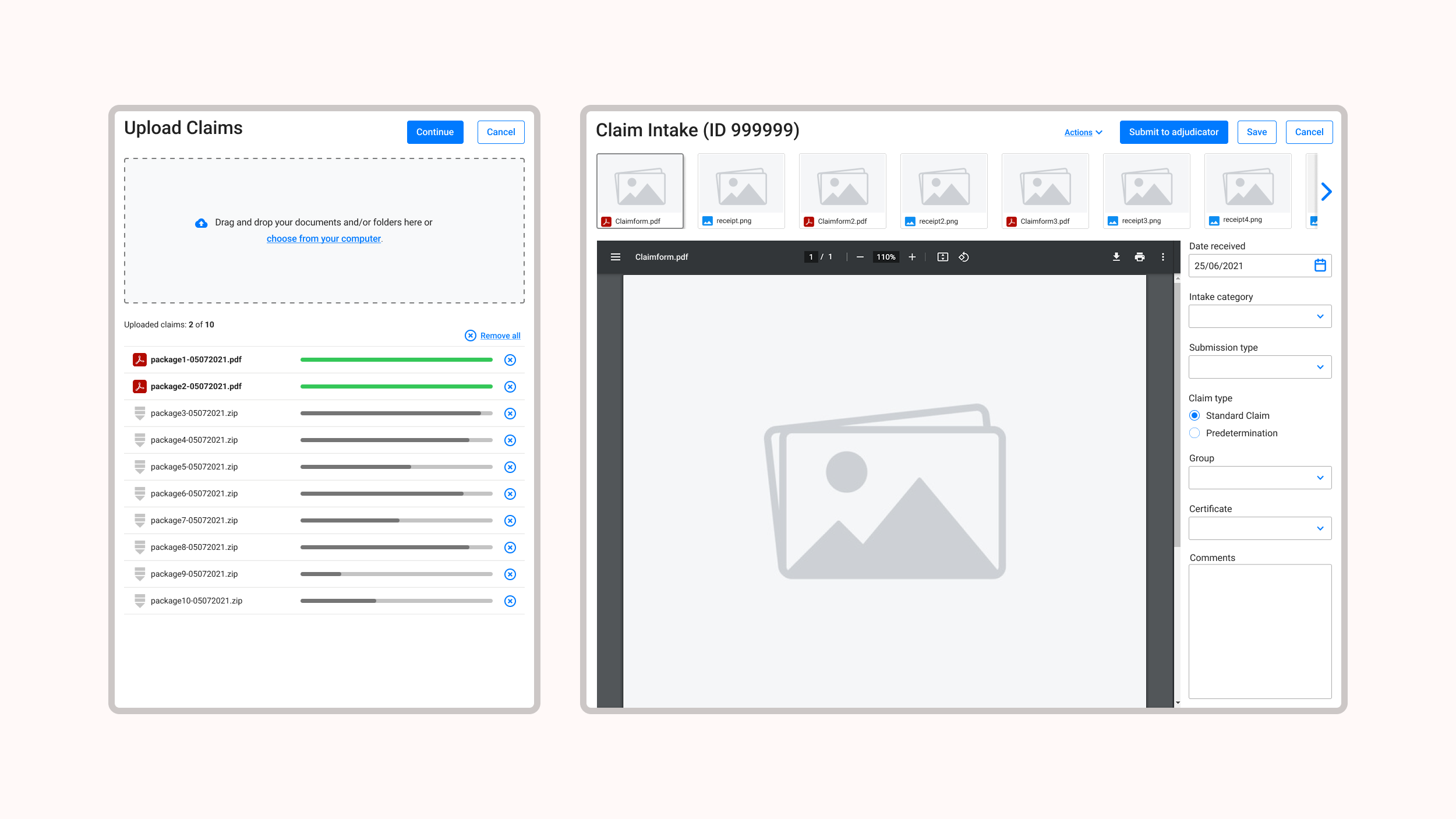
I led the design from discovery workshops to final delivery of a centralized claim intake feature that allowed clerks to upload, prepare, and attach documentation before routing claims — eliminating duplicate entry and improving processing efficiency.
Understanding the problem
Methods: Discovery workshops with client representatives from 3 insurance companies and stakeholders
I led the full end-to-end research and discovery process:
- Stakeholder and client interviews to understand the existing manual workflows
- Journey mapping workshops with the client to visualize pain points and inefficiencies
- Problem statement discovery based on the mapped journey
- Validation sessions to confirm that the identified problems matched real operational challenges
This collaborative exploration helped validate the most efficient intake workflow before moving into detailed design.
Defining key design goals
From the research and journey mapping exercises, we established the following goals:
- Reduce manual data entry for adjudicators
- Centralize and organize incoming claims (mail, scan, email) into a unified workflow
- Enable intake clerks to quickly upload, prepare and categorize claims
- Improve traceability and reduce errors before claims reach adjudicators
- Provide a scalable and efficient foundation for future claims automation
These goals helped frame the "How Might We" questions to guide the brainstorming sessions with clients and internal teams.
Ideation & exploration
I explored multiple ways to streamline intake workflows before committing to a direction:
- Created early concepts and wireframes depicting multiple intake flow options
- Collaborated with clients to refine flows and gather operational feedback
- Built iterative wireframes showcasing different import paths (scan, email, batch upload)
- Facilitated brainstorming sessions using the problem statements and "How Might We" to generate solutions
This collaborative exploration helped validate the best direction before moving into detailed design.
Iterative design
Method: User testing and feedback sessions with the clients and our team stakeholders
Approach: Show → Discuss → Collect feedback → Refine
Once a direction was established, I created a mid-fidelity prototype to test and validate:
- Claim upload and import process
- Metadata entry and required fields
- Sorting, grouping and preparing claims
- Error handling, statuses and progress indicators
- Usability and workflow efficiency
Feedback from clerks and adjudicators helped refine detailed functionality and interactions before moving to high fidelity.
These sessions ensured the workflow supported high-volume claim processing efficiently.
Final design solution
I delivered polished, developer-ready designs for all key flows, including:
✓ Centralized inbox for scanned and emailed claims in a new claim intake section.
✓ Batch import tools to quickly upload multiple documents.
✓ Claim preparation workflows allowing clerks to categorize, verify and prepare files.
✓ Clear statuses and indicators for in-progress, ready-for-review and flagged claims.
✓ Seamless handoff to adjudicators, reducing manual data entry and improving throughput.
This solution significantly reduced the adjudicators' workload and standardized the intake process across teams.
Outcome
Initially adopted by a small number of clients — primarily organizations still receiving claims through traditional channels — the feature gave clerks a structured digital intake process where none previously existed.
Clients reported meaningful time savings, no longer having to enter claims from scratch, and feedback on the streamlined workflow was consistently positive.
Reflection
This project reinforced how impactful thorough discovery with actual users can be. I really enjoyed leading the end-to-end research workshops — it allowed us to understand users deeply and design a solution that made a meaningful difference in their day-to-day work.